
See how Mothership's National LTL Partner Carriers actually perform, so you can pick the right carrier for every shipment. We show you the real numbers, in plain terms, so you can choose based on what matters most to your business.
What is the LTL Carrier Scorecard?
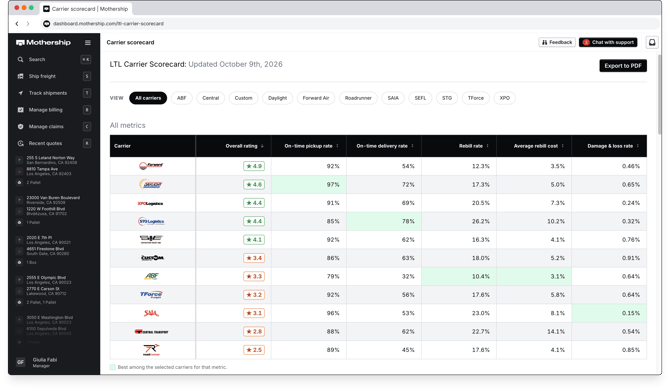
The scorecard shows real performance data for each of our National LTL partner carriers. For each carrier, you'll see:
- On-time pickup rate
- On-time delivery rate
- Rebill rate
- Average rebill cost
- Damage & loss rate
- One overall rating from 1 to 5
Each metric is the carrier's actual rate on Mothership shipments. The overall rating rolls those rates into one number, so you can get a quick read on a carrier.
Where do I find the LTL Carrier Scorecard?
The scorecard is in your Mothership dashboard: Carrier Scorecard. You can also click your name in the bottom-left corner of the dashboard, then select Carrier Scorecard. Select one or more carriers to filter the scorecard and compare them side by side. Click export to download a PDF to share with teammates.
What does each metric mean?
- On-time pickup rate (higher is better): The percentage of shipments a carrier picks up on the requested pickup date. If a pickup moves because of a change on your side, it still counts as on time for the carrier.
- On-time delivery rate (higher is better): The percentage of shipments a carrier delivers within the originally quoted transit business days. If you caused a pickup delay, we adjust for it, so the carrier isn't penalized.
- Rebill rate (lower is better): The percentage of shipments where the carrier adds a charge after the original invoice. A shipment with more than one rebill counts once. For example, a 10% rebill rate means about 10 out of every 100 shipments had a rebill. Rebill rates depend a lot on shipment details. When you accurately weigh, measure, classify, and declare all required accessorials upfront, you should see few, if any, rebills.
- Average rebill cost (lower is better): How much a carrier's rebills add to the original shipment cost, shown as a percentage. It is the carrier's total rebill charges divided by the original (pre-rebill) cost of its shipments. For example, $10 of rebills on a $100 shipment is 10%.
- Damage & loss rate (lower is better): The percentage of shipments with a damage or loss claim while the freight was in the carrier's network.
Amazon, trade show, and appointment shipments are not counted in the on-time pickup and on-time delivery rates.
How much does each metric count toward the overall rating?
On-time delivery counts the most. The weights are:
- On-time delivery rate: 40%
- Rebill rate: 20%
- Average rebill cost: 15%
- Damage & loss rate: 15%
- On-time pickup rate: 10%
How is the overall rating calculated?
The overall rating is a weighted score from 1 to 5. Here's how we calculate it:
- Compare each metric to the network average. For each metric, we compare the carrier's rate with the average across all of our National LTL partner carriers, weighted by shipment volume. Matching the network average scores 100. Doing better than average scores above 100, and doing worse scores below 100. For rebill rate, average rebill cost, and damage & loss rate, a lower rate is better, so a lower rate earns a higher score.
- Keep each metric score between 50 and 150. This stops one unusually high or low number from outweighing everything else.
- Apply the weights. We multiply each metric score by its weight and add them up. The result is the carrier's overall score, where 100 means exactly network average.
- Convert the score to a 1 to 5 rating. Every 10 points equals one star: a score of 85 is a 2.0, 95 is a 3.0, 105 is a 4.0, and so on, rounded to one decimal. A carrier that exactly matches the network average gets a 3.5. The highest possible rating is 4.9.
Example: A carrier scores 120 on on-time delivery and exactly 100 on the other four metrics. Its overall score is (40% × 120) + (60% × 100) = 108, which is a 4.3 rating.
What time period does the scorecard cover?
It varies by metric. On-time pickup and on-time delivery use the last 60 days of Mothership shipments. Rebill rate, average rebill cost, and damage & loss rate use the last 120 days.
Why doesn't a carrier have a rating?
A carrier needs at least 100 Mothership shipments in the last 60 days to get an overall rating. Below that, there isn't enough data for a fair rating yet. This doesn't mean the carrier performs poorly. It just means we need more recent shipment volume to score it.
How often is the scorecard updated?
Metrics are updated every 30 days and are calculated on a rolling basis.
How should I use the scorecard to pick a carrier?
Every business weighs things differently. Start with the metric that matters most to you, then compare carriers on it.
- Need it there on time? Compare on-time delivery rates.
- Working with a tight pickup window? Check on-time pickup rates.
- Shipping fragile or high-value freight? Look for a low damage & loss rate.
- Want fewer surprise charges? Check rebill rate and average rebill cost, and send accurate shipment details upfront.
- Want a quick read? Start with the overall rating, which weights on-time delivery most heavily, then check the metric that matters most to you.